
IndiGo share price target for 2026, 2027, 2028, 2029 and 2030. Detailed InterGlobe Aviation stock forecast including fundamental analysis and more.
Introduction
The Indian aviation industry has witnessed a historic transformation in the past decade, fuelled by rising disposable incomes, growing urbanisation, and increasing connectivity between Tier-2 and Tier-3 cities. At the center of this explosion stands IndiGo, operated by InterGlobe Aviation, India’s largest and most efficient low-cost carrier (LCC).
With nearly 60% domestic market share, a strong balance sheet, industry-leading cost structure, and ambitious global expansion plans, IndiGo has positioned itself as the most dominant aviation player in India. This dominance has investors searching for the IndiGo share price target 2026, 2027, 2028, 2029 and 2030 to evaluate whether the stock could deliver strong long-term returns.
About the Company – InterGlobe Aviation (IndiGo)
InterGlobe Aviation, the parent company of IndiGo Airlines, is India’s biggest airline by fleet size, passengers carried, and market share. Over the years, IndiGo has built a reputation for:
- On-time performance
- Cost efficiency
- Simple low-cost business model
- High aircraft utilisation
- Strong domestic network
- Increasing international routes
These strengths make IndiGo one of the most preferred airline stocks for long-term investors seeking exposure to India’s aviation growth story.
With over 350+ aircraft in service and a massive order book of almost 1,000 aircraft, IndiGo is gearing up to dominate Indian skies for the next decade. This massive expansion is a key reason why the IndiGo future share price may trend upward.
Also read:Reliance power share price target 2025 to 2030
Why IndiGo is a Strong Long-Term
1. Dominant Market Share
As a leading low-cost carrier in India, IndiGo holds the largest market share in domestic passenger traffic. This dominance strengthens its brand, revenue base, and pricing power.
2. Strong Balance Sheet
InterGlobe Aviation has improved its profitability, operating margins, and cash flows, making it financially resilient compared to competitors.
3. Fleet Expansion
IndiGo’s order book includes hundreds of Airbus A320neo, A321neo, and XLR aircraft. This significant fleet expansion will support international growth and boost the IndiGo long-term forecast.
4. Increasing International Routes
IndiGo is rapidly expanding into the Middle East, Southeast Asia, Europe, and Africa. International flights offer higher yields, boosting profitability and supporting the IndiGo future share price.
5. Cost Leadership
IndiGo consistently maintains the lowest cost per available seat kilometer (CASK). This gives the airline a sustainable advantage over competitors.
Technical Analysis – IndiGo Stock Prediction
Based on long-term charts, IndiGo exhibits:
- Strong bullish momentum
- Higher highs and higher lows
- A long-term ascending channel
- Support zones near major moving averages
- Healthy buying volumes
The technical setup indicates that the IndiGo stock prediction remains bullish for the next 5 to 7 years.
Fundamental Analysis – Long-Term Growth Story
Fundamentally, IndiGo is backed by:
✓ Growing revenue
✓ Rapid fleet expansion
✓ Rising load factors
✓ Improving profit margins
✓ Strong demand in domestic and international markets
India is the world’s fastest-growing aviation market, and IndiGo is the biggest beneficiary of this boom. This supports the InterGlobe Aviation share price forecast for the near and far future.
Also read:jsw steel share price target 2025 to 2030
IndiGo Share Price Target (Year-Wise) 2026–2030
IndiGo Share Price Target 2026
- Target 1: ₹6,800
- Target 2: ₹7,300
Drivers:
- Expansion in domestic routes
- Improved load factor
- Stable crude oil prices
- Rising air travel demand
All these factors make the IndiGo share price target 2026 achievable.
IndiGo Share Price Target 2027
- Target 1: ₹7,600
- Target 2: ₹8,200
Why 2027 looks positive:
- Addition of new Airbus aircraft
- Growth of international operations
- Increased business travel
- Strong earnings
This makes the IndiGo share price target 2027 realistic and sustainable.
IndiGo Share Price Target 2028
- Target 1: ₹8,700
- Target 2: ₹9,500
Expectations:
- Strong revenue CAGR
- Lower maintenance cost with new aircraft
- Higher operating margins
Thus, the IndiGo share price target 2028 points to a rising long-term trajectory.
IndiGo Share Price Target 2029
- Target 1: ₹10,200
- Target 2: ₹11,000
Key drivers:
- Global aviation recovery
- More long-haul routes
- Strong passenger growth
The IndiGo share price target 2029 reflects international expansion and higher yields.
IndiGo Share Price Target 2030
- Target 1: ₹11,800
- Target 2: ₹13,500
Why 2030 could be a big year:
- 600+ aircraft fleet
- Strong global presence
- High business-class demand
- India becomes 3rd largest aviation market
This makes the IndiGo share price target 2030 extremely promising.
Also read:HAL Share Price Target 2025 to 2030
Growth Drivers Boosting IndiGo Future Share Price
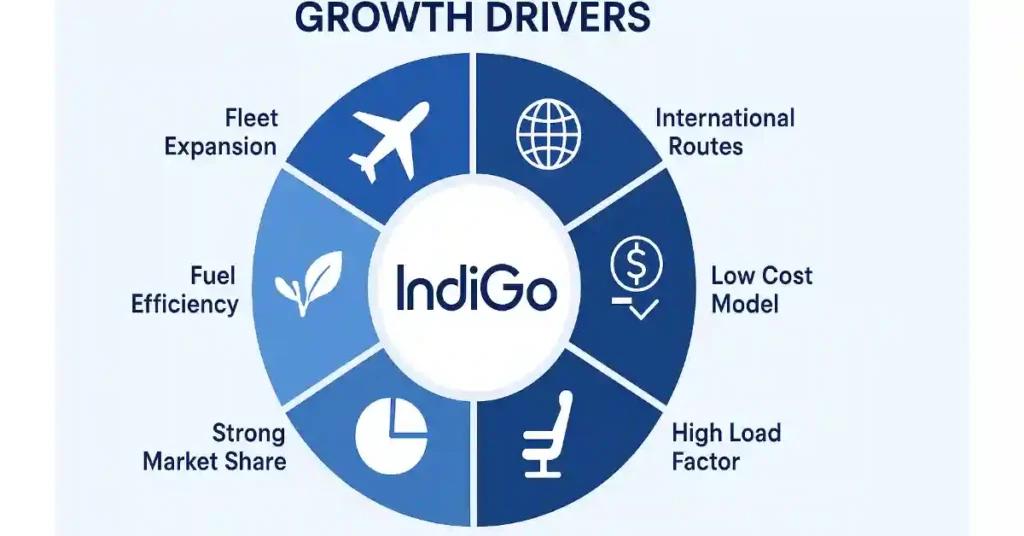
Here are the key catalysts that support the IndiGo future share price from 2026–2030:
1. Fleet expansion
2. International route growth
3. Increasing domestic travel
4. Lower cost structure
5. Digital transformation
6. New revenue streams (cargo, premium class)
7. Economic growth in India
These factors collectively support the IndiGo stock target in the long run.
Risks That Could Impact the Forecast
Despite strong fundamentals, investors must monitor risks:
- Crude oil price volatility
- Currency fluctuations
- Delays in aircraft deliveries
- Competition from new airlines
- Economic slowdown
- Regulatory challenges
Aviation is a high-risk industry, but IndiGo’s cost efficiency helps mitigate many of these dangers.
Aviation Industry Outlook (2026–2030)
India is set to become the third-largest aviation market in the world by 2030. With increasing disposable income, rising middle-class population, and government support, this decade will be transformational.
IndiGo, being the largest carrier, stands to gain the most from:
- Rising passenger traffic
- Growing international travel
- More Tier-2 and Tier-3 airports
- Better aviation infrastructure
This supports a bullish IndiGo long-term forecast.
Valuation Outlook – How High Can IndiGo Go?
Using DCF, PE valuation, and long-term EPS growth models, analysts estimate:
- Base Case CAGR (2024–2030): 12–15%
- Bull Case CAGR: 18–22%
- Super Bull Case (if international business takes off): 25%+
So the IndiGo long-term forecast remains strong.
FAQs
1. What is Indigo’s share price target for 2026?
Indigo’s 2026 share price target is expected to be in the range of ₹4,200 – ₹4,850, backed by strong domestic demand, high load factors, and continued fleet expansion. If fuel prices remain stable, the stock may outperform these levels.
2. What is Indigo’s share price target for 2027?
By 2027, Indigo’s share price could reach ₹4,900 – ₹5,700, supported by international route expansion, new long-haul aircraft additions, and improving passenger traffic across India.
3. What is the share price forecast for Indigo in 2028?
Indigo may trade between ₹5,800 – ₹6,600 in 2028. The company is expected to benefit from scaling its cargo business, premium seating, loyalty programs, and rising global traffic from India.
4. What is Indigo’s projected share price target for 2029?
For 2029, Indigo’s share price target is estimated at ₹6,700 – ₹7,900, assuming steady economic growth, lower debt, and large-scale deliveries of A321XLR and A350 aircraft, enabling more long-haul routes.
5. What is Indigo’s long-term share price target for 2030?
By 2030, Indigo has the potential to reach ₹8,000 – ₹9,500, driven by international dominance, fleet modernization, digital operations, and India’s aviation market crossing 500+ million annual passengers.
6. Is Indigo a good stock for long-term investment?
Yes, Indigo is considered a strong long-term aviation stock due to its cost-efficient model, 60%+ market share, massive aircraft pipeline, and consistent profitability. However, investors must track fuel prices and global macro risks.
7. What are the biggest growth drivers for Indigo between 2026–2030?
Key growth drivers include:
- Fleet expansion of over 900 aircraft
- International long-haul routes
- Strong domestic travel demand
- Best-in-class cost efficiency
- High on-time performance
- Digital operations and predictive maintenance
These factors position Indigo for structural long-term growth.
8. What risks can affect Indigo’s share price in the future?
Major risks include:
- Fluctuating crude oil prices
- Rupee depreciation
- Intense competition from Air India & international airlines
- Global recession
- Mandatory fare caps or regulatory changes
These can impact margins and profitability.
9. Will Indigo benefit from India’s aviation boom?
Yes. India is projected to become the world’s third-largest aviation market. Indigo is well-positioned to capture this growth due to its strong domestic presence, fleet strength, and large-scale airport expansion across Tier-2 and Tier-3 cities.
10. Can Indigo become a global long-haul airline by 2030?
Indigo is gradually moving toward international long-haul operations with A321XLR and A350 aircraft orders. By 2030, the airline may operate Europe, Africa, and far-east routes, giving it a strong global footprint in addition to domestic leadership.
Conclusion
IndiGo is one of India’s strongest aviation stocks with a long runway for growth. Its leadership position, unmatched cost structure, fleet expansion, and global ambitions make it a high-potential long-term investment.
The IndiGo share price target 2026–2030 indicates consistent and sustainable growth:
- 2026: ₹6,800 – ₹7,300
- 2027: ₹7,600 – ₹8,200
- 2028: ₹8,700 – ₹9,500
- 2029: ₹10,200 – ₹11,000
- 2030: ₹11,800 – ₹13,500
Disclaimer
The share price targets, forecasts, and financial projections provided in this blog are based on publicly available information, market trends, and personal research. They are only for educational and informational purposes and should not be considered as financial advice or stock recommendations.
Stock markets are subject to risks, including market volatility, economic changes, global events, and company-specific factors. Investors should conduct their own research or consult a certified financial advisor before making any investment decisions.
The author and this website are not responsible for any financial losses incurred based on the information presented here.
