


Confused about ASBA (Application Supported by Blocked Amount) in IPOs? This guide explains ASBA meaning, full form, process, benefits.
Introduction
The Indian stock market has evolved rapidly over the past two decades, and the IPO (Initial Public Offering) process has become smoother, faster, and more secure. One of the biggest contributors to this evolution is ASBA — Application Supported by Blocked Amount.
Introduced by SEBI (Securities and Exchange Board of India) in 2008, ASBA has completely changed the way investors apply for IPOs. It ensures that investors’ money remains safe in their bank account until they are allotted shares. This mechanism promotes transparency, eliminates refund delays, and simplifies IPO participation.
In this complete guide, we will cover everything about ASBA — from its meaning and process to its advantages, SEBI rules, step-by-step application, examples, and FAQs. Whether you’re a first-time investor or a seasoned trader, this 2025 ASBA guide will make IPO investing simple and clear.
What is ASBA?
ASBA stands for “Application Supported by Blocked Amount.”
It is a process introduced by SEBI that allows investors to apply for IPOs, FPOs, rights issues, and debt issues without transferring money upfront. Instead of paying the amount immediately, the investor’s funds are blocked in their bank account until the shares are allotted.
If the investor receives shares in the allotment, the required amount is debited from the account. If not, the blocked funds are simply released back — no refund delays, no extra steps.
ASBA Full Form and Meaning
Let’s break down the ASBA full form to understand its meaning:
- A – Application
- S – Supported
- B – By
- A – Blocked Amount
In simple words, it means your IPO application is supported by an amount that remains blocked in your bank account until allotment.
So, instead of transferring money to a broker or intermediary, you simply give authorization to your bank (known as a Self Certified Syndicate Bank or SCSB) to block the required amount.
Why SEBI Introduced ASBA
Before ASBA, the IPO process involved physically applying for shares and transferring the entire amount upfront. If you didn’t get shares, you had to wait weeks for the refund. This caused:
- Delay in refunds
- Chances of errors and misuse
- Unnecessary freezing of funds
- Lack of transparency
To solve these issues, SEBI made ASBA mandatory for all IPOs from 2016 onwards. It ensured:
- Investor protection
- Efficient fund management
- Quick refunds (via automatic unblocking)
- Transparent allotment process
How ASBA Works (Step-by-Step Process)

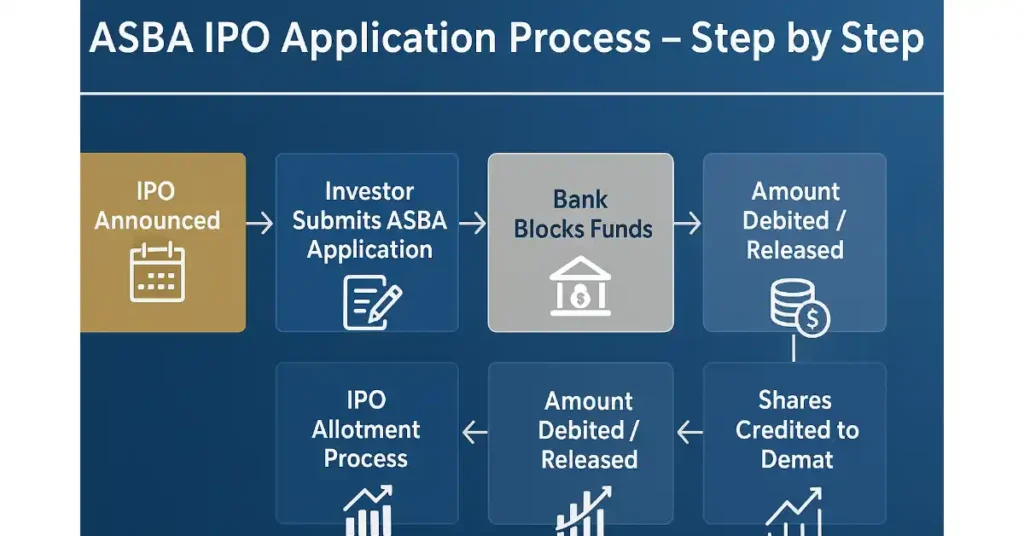
Let’s understand how ASBA works in a simple 7-step process:
Step 1: Investor decides to apply for an IPO
You check IPO details like price band, lot size, and open/close dates.
Step 2: You log in to your bank account or visit your branch
Most major Indian banks offer ASBA online through net banking. Alternatively, you can fill a physical ASBA form at your bank.
Step 3: Select the IPO you want to apply for
Your bank lists all active IPOs eligible for ASBA.
Step 4: Enter bid details
You fill in:
- Quantity of shares (in multiples of lot size)
- Price (cut-off or specific bid)
- PAN number
- Demat account details
Step 5: Authorization to block funds
You authorize your bank to block the required amount in your account.
The money is not debited — it remains in your account but can’t be used until allotment.
Step 6: Application submission to the exchange
The bank submits your ASBA application to the stock exchange electronically.
Step 7: Allotment and debit/unblock
If you get an allotment:
- The amount equivalent to the shares allotted is debited.
If you don’t: - The blocked amount is released automatically.
Example of ASBA in Real Life
Imagine you apply for an IPO worth ₹15,000 through ASBA.
- Your bank blocks ₹15,000 in your savings account.
- After IPO allotment:
- If you get shares worth ₹10,000 → Only ₹10,000 is debited.
- ₹5,000 is released automatically.
- If you get no shares, the full ₹15,000 becomes available instantly.
No refund delays, no paperwork — that’s the power of ASBA.
ASBA in IPO – Key Benefits
ASBA has several advantages for investors applying in IPOs:
No Upfront Payment
Your funds stay in your account until allotment.
Earn Interest
Since the amount remains in your savings account, you continue earning interest on it.
No Refund Delays
No waiting for refunds — unblocking happens automatically.
Safe and Transparent
Funds are blocked in your own bank account, reducing the risk of fraud.
Easy Online Access
Almost all major banks provide ASBA through internet banking and mobile apps.
SEBI-Approved Process
ASBA is regulated by SEBI, ensuring full investor protection.
Banks Providing ASBA Facility (SCSBs List)
Banks that offer ASBA are called Self Certified Syndicate Banks (SCSBs).
Some popular ASBA banks in India include:
- State Bank of India (SBI ASBA)
- HDFC Bank ASBA
- ICICI Bank ASBA
- Axis Bank
- Kotak Mahindra Bank
- Canara Bank
- Punjab National Bank (PNB)
- Bank of Baroda
- Union Bank of India
- IDBI Bank
- Yes Bank
- IndusInd Bank
These banks support both online and offline ASBA applications.
How to Apply for IPO Through ASBA (Online Method)
Here’s the online ASBA IPO process most investors follow:
- Log in to your net banking account.
- Go to the IPO/ASBA section.
- Choose the active IPO you want to apply for.
- Enter bid quantity, price, and PAN/Demat details.
- Authorize to block funds.
- Submit your application.
- You will receive an acknowledgment or reference number.
That’s it — your IPO application is complete!
How to Apply for IPO Through ASBA (Offline Method)
If you prefer the traditional route:
- Collect the ASBA form from your bank or broker.
- Fill in all details like name, PAN, DP ID, client ID, bid quantity, and price.
- Submit it to the bank branch (SCSB).
- The bank uploads your details electronically.
- You receive a stamped acknowledgment copy.
ASBA vs UPI in IPO
Both ASBA and UPI are methods to apply for IPOs — but they differ slightly.
| Feature | ASBA | UPI |
|---|---|---|
| Introduced By | SEBI | NPCI |
| Account Type | Bank Account | Linked Bank via UPI |
| Fund Handling | Amount Blocked | Mandate Created |
| Refund | Auto unblocking | Auto release |
| Application Limit | Up to ₹2 lakh (Retail) | ₹5 lakh (New UPI Limit) |
| Platform | Bank Portal | Broker / App |
| Control | Direct via Bank | Via UPI App |
| Reliability | Very High | Depends on UPI network |
Both are SEBI-approved, but ASBA is still considered more reliable and safer for large investors.
SEBI Guidelines for ASBA
SEBI has issued several guidelines to protect investors:
- All IPOs must mandatorily use ASBA for all categories.
- Only SCSBs can block funds.
- The blocked amount must be visible in the investor’s account.
- Unblocking should occur within 1 working day after allotment.
- Banks must maintain records of ASBA transactions for audit.
These rules ensure fair and efficient IPO participation for all investors.
Advantages and Disadvantages of ASBA
Advantages
- Safe, secure, and transparent
- Earn interest during blocking period
- No refund delays
- SEBI regulated
- Easy online access
- Works across IPO, FPO, and rights issues
Disadvantages
- Not all small banks support ASBA
- Offline forms may be time-consuming
- Requires active Demat and PAN link
- Limited to specific categories of investors
ASBA Refund Process
Refunds are handled automatically under ASBA:
- If you don’t get any shares → Full amount is released.
- If you get partial allotment → Only the balance is released.
- Refund happens instantly after allotment finalization.
You can check your ASBA refund status on your bank’s net banking portal or IPO registrar website.
ASBA Application Status Check
To track your ASBA IPO status:
- Visit your bank’s net banking portal.
- Go to ASBA section → Application history.
- You’ll see your IPO name, blocked amount, and status.
- Alternatively, visit NSE/BSE IPO status pages or registrar websites like Link Intime or KFintech.
Common Myths About ASBA
Myth 1: ASBA means money is deducted immediately.
Fact: Money remains blocked, not debited.
Myth 2: Only online users can use ASBA.
Fact: Offline ASBA forms are also available.
Myth 3: Refunds take weeks.
Fact: Refunds (unblocking) are instant under ASBA.
Myth 4: ASBA is not available in small banks.
Fact: Over 50+ SCSBs are approved by SEBI.
ASBA for Rights Issues and NCDs
ASBA isn’t just for IPOs — it can also be used for:
- Rights Issues (additional shares offered to existing shareholders)
- Follow-on Public Offers (FPOs)
- Debt Issues / NCDs
This makes ASBA a multi-purpose investment tool.
ASBA and Retail Investors
For retail investors applying for IPOs below ₹2 lakh, ASBA is the most convenient option.
They can:
- Apply directly from their bank account
- Track everything in one place
- Avoid dealing with brokers or intermediaries
With ASBA, retail participation in IPOs has increased significantly.
ASBA and Institutional Investors
Institutional and HNI investors also use ASBA for larger bids.
It simplifies fund blocking and reduces refund processing time.
Future of ASBA
In 2025, SEBI is expected to integrate UPI + ASBA hybrid models for smoother IPO applications.
New updates may include:
- Real-time status tracking
- Instant allotment visibility
- API-based fund verification between banks and exchanges
ASBA will continue to play a vital role in India’s growing capital markets.
Final Thoughts – Why Every Investor Should Use ASBA
ASBA represents a safe, smart, and modern way to apply for IPOs.
It combines transparency, efficiency, and convenience, ensuring investor confidence.
Whether you’re applying for your first IPO or your fiftieth, ASBA should always be your preferred method.
FAQs
Q1: What is ASBA in simple terms?
ASBA means your IPO application is supported by an amount that stays blocked in your account until allotment.
Q2: Is ASBA mandatory for IPOs?
Yes, SEBI has made ASBA mandatory for all IPO applications.
Q3: Can I apply IPO through ASBA using SBI net banking?
Yes. SBI, HDFC, ICICI, and many banks offer ASBA through internet banking.
Q4: Can I use UPI and ASBA together?
Yes. Many brokers integrate ASBA and UPI for a hybrid application experience.
Q5: How long does it take for ASBA refund?
Refunds are automatic and usually completed within 1 business day after allotment.
Q6: What is the benefit of ASBA over traditional IPO application?
Your money remains in your bank, you earn interest, and refunds are instant.
Q7: What if I enter wrong details in ASBA?
Your application may be rejected. Always double-check your PAN and Demat details.
Conclusion
ASBA (Application Supported by Blocked Amount) has transformed IPO investing in India. It is secure, efficient, SEBI-approved, and designed to protect retail investors.
By understanding how ASBA works, using it through your bank, and following SEBI’s simple rules, you can apply for IPOs confidently and smartly.
In 2025 and beyond, ASBA remains the gold standard for IPO applications in India.
Disclaimer
The information provided in this article about ASBA (Application Supported by Blocked Amount) is for educational and informational purposes only. It does not constitute financial, investment, or legal advice. Readers are advised to verify details such as IPO timelines, SEBI guidelines, and bank policies directly from official sources before making any investment decisions. The author and publisher are not responsible for any financial losses or actions taken based on this content. Always consult a qualified financial advisor or your registered bank before applying for IPOs through ASBA.

